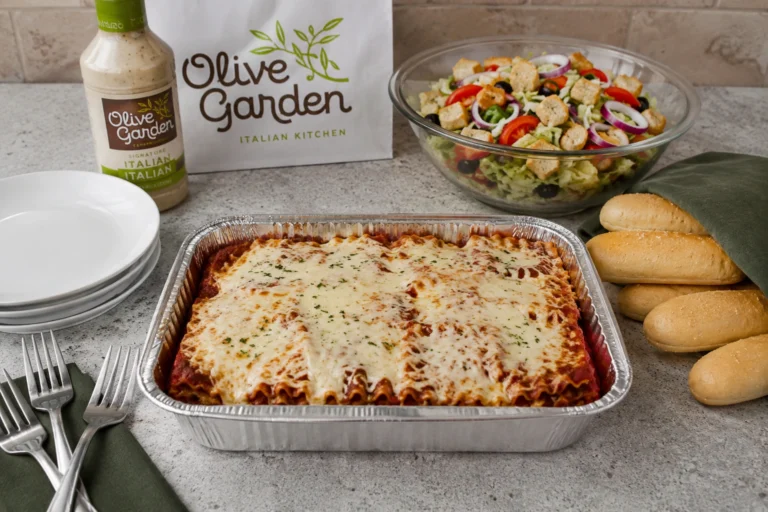
Quick Answer: Olive Garden’s nutrition menu covers calories, fat, sodium, carbs, and protein for every item, from pasta and sauces to soups, appetizers, and desserts. Lighter entrée choices start around 290 calories (Spaghetti with Marinara), while some appetizers exceed 1,200 calories. Sodium is high across most categories, often exceeding 1,000mg per dish.
What Is the Olive Garden Nutrition Menu?
The Olive Garden nutrition menu is a full breakdown of macronutrients and key dietary values for every dish on the menu, including pasta, sauces, toppings, soups, salads, appetizers, entrées, gluten-free options, kids’ meals, drinks, and desserts.
Whether you’re tracking calories, monitoring sodium for heart health, counting protein, or just trying to avoid a meal that leaves you feeling heavy, the nutrition data helps you order with confidence instead of guessing.
One thing most people don’t realize until they look: the sauce and topping you choose can matter more than the pasta itself. Alfredo sauce alone adds 870 calories and 87g of fat. Swapping it for marinara drops that to 150 calories with minimal fat.
Olive Garden Pasta Nutrition
Plain pasta is one of the lightest parts of any Olive Garden order. The noodle itself is low in fat and moderate in calories, the sauce is where the numbers climb fast.
| Pasta | Calories | Total Fat (g) | Carbs (g) | Protein (g) |
|---|---|---|---|---|
| Fettuccine | 350 | 2.5 | 67 | 12 |
| Spaghetti | 340 | 3.5 | 67 | 12 |
| Angel Hair | 350 | 2.5 | 67 | 12 |
| Rigatoni | 440 | 6 | 83 | 14 |
| Gluten-Free Rotini | 380 | 3.5 | 77 | 9 |
Spaghetti and Angel Hair are the lightest pasta choices. Rigatoni carries more carbs due to its size and density. Gluten-Free Rotini has slightly more calories than regular pasta, with a notable 260mg sodium and 100mg cholesterol compared to near-zero in wheat options.
Olive Garden Sauce Nutrition: Where Calories Spike
This is the most important table to study. Choosing between Alfredo and Marinara is not a minor swap, it’s a difference of 720 calories.
| Sauce | Calories | Total Fat (g) | Sat. Fat (g) | Sodium (mg) |
|---|---|---|---|---|
| Marinara | 150 | 9 | 0.5 | 1,280 |
| Meat Sauce | 300 | 19 | 7 | 1,040 |
| Garlic Herb | 470 | 36 | 18 | 2,160 |
| Five Cheese Marinara | 400 | 33 | 17 | 1,300 |
| Alfredo | 870 | 87 | 54 | 1,200 |
| Creamy Mushroom | 860 | 87 | 54 | 1,090 |
Every sauce on this list contains over 1,000mg of sodium. For context, the American Heart Association recommends no more than 2,300mg of sodium per day total. A single pasta dish with sauce can use up more than half that allowance. If sodium is a concern, Meat Sauce is the relatively lower-sodium option at 1,040mg.
Olive Garden Toppings Nutrition
| Topping | Calories | Total Fat (g) | Protein (g) | Sodium (mg) |
|---|---|---|---|---|
| Chicken Fritta | 240 | 1.5 | 20 | 730 |
| Italian Sausage | 470 | 39 | 27 | 1,140 |
| Meatballs | 480 | 40 | 23 | 1,060 |
Chicken Fritta is the clear winner for anyone watching fat and calories while still wanting added protein. Italian Sausage and Meatballs both push the fat count dramatically, meatballs add nearly as many calories as a full side dish.
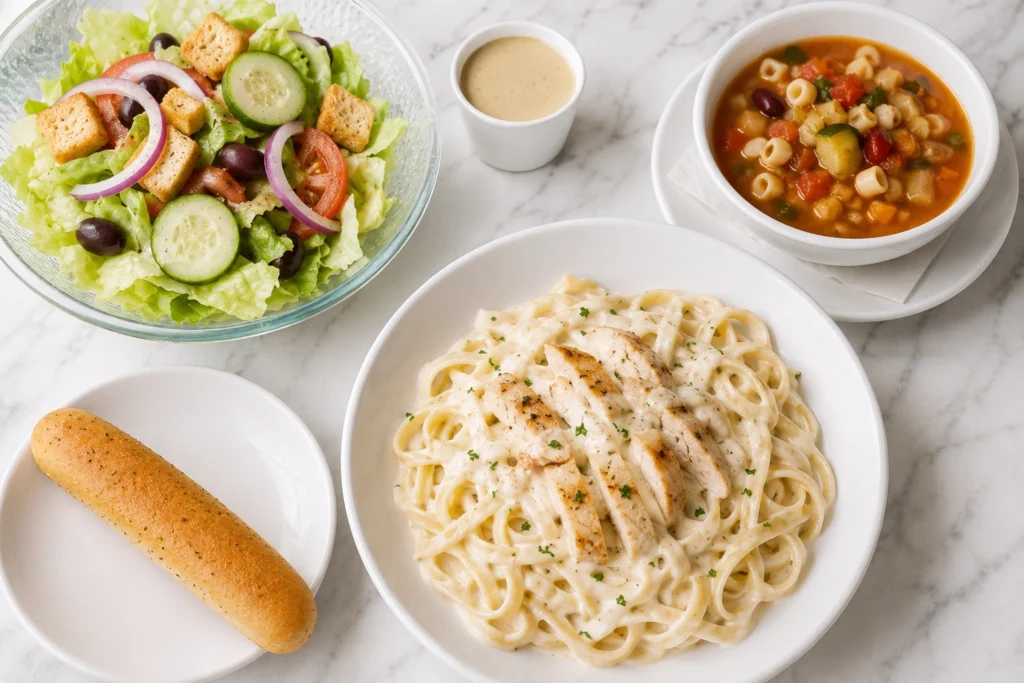
Soups, Salad & Breadsticks Nutrition
The “unlimited soup, salad, and breadsticks” offer is a classic Olive Garden draw — but the numbers add up quickly if you go back for multiple rounds.
| Item | Calories | Total Fat (g) | Sodium (mg) | Protein (g) |
|---|---|---|---|---|
| Breadstick with garlic (1) | 140 | 2.5 | 460 | 4 |
| Breadstick, plain (1) | 130 | 1 | 280 | 4 |
| Chicken & Gnocchi Soup | 230 | 12 | 1,290 | 11 |
| Minestrone Soup | 110 | 1 | 810 | 5 |
| Pasta Fagioli Soup | 150 | 5 | 710 | 8 |
| Zuppa Toscana | 220 | 15 | 790 | 7 |
| Salad with Italian Dressing | 150 | 10 | 770 | 1 |
| Salad without Dressing | 70 | 2 | 250 | 2 |
Minestrone Soup at 110 calories is the lightest soup option with the lowest fat. Pasta Fagioli offers solid protein relative to its calorie count. Asking for the salad without dressing and adding one packet of Low-Fat Italian Dressing (30 calories, 2g fat) is significantly lighter than the standard 150-calorie dressed version.
One breadstick is fine. Three breadsticks with garlic topping = 420 calories and 1,380mg of sodium before your entrée arrives.
Appetizer Nutrition: The Highest-Calorie Category
Appetizers at Olive Garden carry some of the most extreme numbers on the menu. Treating them as a light starter before an entrée can easily push a single meal over 2,000 calories.
| Appetizer | Calories | Total Fat (g) | Sodium (mg) |
|---|---|---|---|
| Calamari | 670 | 42 | 1,600 |
| Shrimp Fritto Misto | 1,290 | 79 | 5,010 |
| Fried Mozzarella | 800 | 49 | 1,990 |
| Lasagna Fritta | 1,130 | 75 | 2,800 |
| Meatballs Parmigiana | 1,040 | 83 | 2,500 |
| Spinach-Artichoke Dip | 1,160 | 81 | 2,440 |
The Shrimp Fritto Misto’s 5,010mg of sodium is more than double the recommended daily limit in a single dish. Calamari, at 670 calories, is the most reasonable appetizer choice, though you’ll still want to skip the spicy ranch dip (240 calories) and opt for marinara instead (35 calories).
Olive Garden Entree Nutrition
| Entrée | Calories | Total Fat (g) | Sodium (mg) | Protein (g) |
|---|---|---|---|---|
| Spaghetti with Marinara | 290 | 6 | 650 | 9 |
| Spaghetti with Meat Sauce | 360 | 12 | 530 | 14 |
| Lasagna Classico | 500 | 18 | 1,290 | 29 |
| Shrimp Scampi | 460 | 18 | 1,020 | 20 |
| Cheese Ravioli with Marinara | 440 | 22 | 1,330 | 25 |
| Fettuccine Alfredo | 650 | 45 | 610 | 15 |
| Chicken Parmigiana | 630 | 29 | 1,970 | 36 |
| Five Cheese Ziti al Forno | 630 | 35 | 1,220 | 26 |
| Eggplant Parmigiana | 660 | 32 | 1,540 | 21 |
| Spaghetti w/ Meat Sauce & Meatballs | 680 | 38 | 1,230 | 30 |
Spaghetti with Meat Sauce gives 14g of protein at 360 calories. Lasagna Classico delivers 29g of protein at 500 calories — solid value for the macros. Chicken Parmigiana has the highest protein at 36g but also carries nearly 2,000mg of sodium.
Gluten-Free Menu Nutrition
| Item | Calories | Sodium (mg) | Protein (g) |
|---|---|---|---|
| Zuppa Toscana Soup | 220 | 790 | 7 |
| Salad without Croutons | 80 | 670 | 2 |
| 6 oz. Tuscan Sirloin | 480 | 1,680 | 46 |
| Herb-Grilled Salmon | 610 | 1,360 | 45 |
| Grilled Chicken Parmigiana with Rotini & Marinara | 810 | 3,040 | 75 |
| Rotini Pasta with Marinara | 530 | 1,530 | 13 |
| Rotini Pasta with Meat Sauce | 680 | 1,300 | 33 |
The Tuscan Sirloin is a standout for the gluten-free diner who wants high protein with moderate calories. The Grilled Chicken Parmigiana with Rotini is filling and protein-dense at 75g, though its 3,040mg sodium content is worth factoring in.
Kids Menu Nutrition
| Kids Item | Calories | Sodium (mg) | Protein (g) |
|---|---|---|---|
| Kids Grilled Chicken with Rotini & Marinara | 380 | 1,310 | 33 |
| Kids Rotini Pasta with Marinara | 260 | 770 | 6 |
| Kids Rotini Pasta with Meat Sauce | 340 | 650 | 12 |
Kids Rotini with Meat Sauce has the lowest sodium among kids’ mains while offering reasonable protein. Grilled Chicken is the highest-protein option but comes with notably elevated sodium for a child’s portion.
Dessert Nutrition
| Dessert | Calories | Total Fat (g) | Carbs (g) |
|---|---|---|---|
| Tiramisu | 470 | 27 | 54 |
| Strawberry Cream Cake | 540 | 26 | 69 |
| Pumpkin Cookie Butter Cheesecake | 620 | 38 | 57 |
| Sicilian Cheesecake | 730 | 42 | 78 |
| Black Tie Mousse Cake | 750 | 50 | 76 |
| Chocolate Lasagna | 980 | 58 | 116 |
| Warm Italian Doughnuts | 810 | 28 | 119 |
Tiramisu is the lightest dessert at 470 calories and the natural choice for anyone who still wants something sweet without crossing into four-digit territory. Chocolate Lasagna and Warm Italian Doughnuts both top 800+ calories and over 115g of carbs, better shared between the table.
Drinks Nutrition
| Drink | Calories | Carbs (g) |
|---|---|---|
| Spiked Strawberry Lemonade | 160 | 21 |
| Peach Bellini | 210 | 23 |
| Sicilian Sunset | 230 | 35 |
| Watermelon Margarita | 230 | 35 |
| Amaretto Sour | 260 | 44 |
| Strawberry Limoncello Margarita | 280 | 43 |
| Italian Rum Punch | 320 | 48 |
| Italian Margarita | 380 | 58 |
Alcoholic drinks here range from 160 to 380 calories purely from sugar and alcohol — zero fat, zero protein. The Spiked Strawberry Lemonade at 160 calories is the lightest option. The Italian Margarita at 380 calories is on par with a light entrée.
How to Order Lower-Calorie at Olive Garden:
1. Start with the soup, not the appetizer.
Order a bowl of Minestrone (110 cal) instead of sharing an appetizer. It takes the edge off hunger before the main arrives, without loading up on sodium or fat.
2. Choose the sauce before the pasta.
Your sauce choice has 5–6x more impact on total calories than your pasta choice. Marinara over Alfredo saves roughly 720 calories on the same plate.
3. Ask for dressing on the side.
A salad without dressing has 70 calories. The dressed version has 150. One packet of low-fat Italian dressing adds only 30 calories. Small change, but it adds up.
4. Limit breadsticks to one.
One plain breadstick is 130 calories and nutritionally fine. Two garlic breadsticks equal 280 calories and 920mg of sodium before you’ve touched your entrée.
5. Share a dessert or order Tiramisu.
Tiramisu at 470 calories is a manageable finish. Everything above that crosses into territory that can push your total meal well past 1,500 calories.
Common Mistakes to Avoid
Ignoring the sauce calories entirely: Most people count the pasta or the protein and forget that the sauce is often the most calorie-dense part of the dish. Alfredo sauce (870 cal) has more calories than many full entrées.
Treating “gluten-free” as “light”: The gluten-free pasta options often have comparable or higher calories than regular options. Gluten-free refers to the ingredient, not the calorie profile.
Underestimating appetizers: Spinach-Artichoke Dip (1,160 cal) eaten before a Fettuccine Alfredo (650 cal) plus a breadstick puts you at roughly 1,950 calories before drinks or dessert. Appetizers here are not starters, they’re often full meals.
Refilling the soup without tracking: Each bowl of Chicken & Gnocchi Soup is 230 calories. Three bowls = 690 calories. Minestrone is a much safer choice for refills at 110 calories per bowl.
Assuming grilled means low-calorie: Herb-Grilled Salmon is 610 calories, healthy fats, high protein, but not light. It’s a quality dish, just not a weight-loss shortcut.
FAQ Section
Q: What are the lowest-calorie entrées on the Olive Garden nutrition menu?
Spaghetti with Marinara (290 calories) is the lightest full entrée. Shrimp Scampi (460 cal) and Lasagna Classico (500 cal) are solid mid-range options that still offer good protein. Avoid adding meatballs, which tack on 480–520 extra calories.
Q: How much sodium is in a typical Olive Garden meal?
Most individual dishes contain 700–2,000mg of sodium. A full meal — soup, salad with dressing, an entrée with sauce — can easily exceed 3,000–4,000mg of sodium, which is well above the 2,300mg daily recommended limit. If you’re managing blood pressure, focus on Meat Sauce (1,040mg) and Minestrone (810mg) as lower-sodium choices.
Q: Does Olive Garden have a gluten-free menu with nutrition information?
Yes. Olive Garden offers gluten-free pasta (rotini) and several naturally gluten-free items like soups, salads without croutons, grilled proteins, and sirloin. Nutrition information is available for all gluten-free items, including sodium and protein content.
Q: Can I customize my Olive Garden order to reduce calories?
Yes. Ask for sauce on the side, swap Alfredo for marinara, skip the garlic topping on breadsticks, request dressing on the side, and choose Grilled Chicken over Chicken Fritta or Meatballs as a topping. Each swap meaningfully reduces both calories and fat.
Q: Are there nutrition facts for kids’ meals at Olive Garden?
Yes. Kids’ meals range from 260 to 380 calories. Kids Rotini with Marinara (260 cal) is the lightest option. Kids Grilled Chicken with Rotini and Marinara (380 cal) has the highest protein at 33g, making it the most balanced option for active kids.
Q: What is the highest-calorie item on the Olive Garden menu?
Among appetizers, Shrimp Fritto Misto stands out at 1,290 calories and 5,010mg of sodium. Among desserts, Chocolate Lasagna reaches 980 calories. The Lasagna Fritta appetizer (1,130 cal) and Meatballs Parmigiana (1,040 cal) are also among the highest.
Q: What drinks at Olive Garden are lowest in calories?
Spiked Strawberry Lemonade has the fewest calories at 160. Peach Bellini (210 cal) and Sicilian Sunset (230 cal) are also relatively light. The Italian Margarita at 380 calories is the highest-calorie cocktail on the current menu.
Q: Is the Olive Garden nutrition menu available online or in the restaurant?
Olive Garden provides nutrition information on its official website and through in-restaurant menu boards. Full macro breakdowns — including calories, fat, sodium, cholesterol, carbs, and protein — are available for every menu category. You can review it before you visit to plan your order in advance.
Conclusion
The Olive Garden nutrition menu gives you everything you need to eat Italian without losing track of what’s on your plate. The key takeaway: pasta is rarely the problem — sauces, appetizers, and those extra breadsticks are where most meals go off course.
Choose Marinara over Alfredo, start with Minestrone instead of a shared appetizer, and cap your breadstick count at one. Those three habits alone can cut 700–1,000 calories from a typical Olive Garden visit without sacrificing the experience.
If you have specific dietary needs, gluten sensitivity, sodium restrictions, or high protein goals, the full nutrition tables above give you the data to plan exactly the right order before you sit down.